Patio and pool deck coatings in Wichita are not a garage floor moved outdoors. South-central Kansas puts exterior concrete through a harder year than almost any interior slab: full summer UV and surface heat, freeze-thaw winters, expansive clay movement under the pad, and constant splash from chlorinated or salt-system pool water. Spec the wrong topcoat or skip edge detail and the deck fails on a schedule you can set your calendar by.
Three constraints drive every exterior job we quote:
- UV stability. Standard epoxy is not a UV-stable topcoat. In full Kansas sun it chalks and ambers within a season. Exterior work gets an aliphatic polyaspartic or polyurethane topcoat — that is non-negotiable.
- Barefoot temperature. Dark colours on a pool deck in July are genuinely unusable without shoes. Colour choice here is a comfort decision first, aesthetic second.
- Wet-foot traction. Wet feet next to water is the worst slip case on a property. Quartz broadcast or an aggressive grit topcoat is the default, not an upgrade.
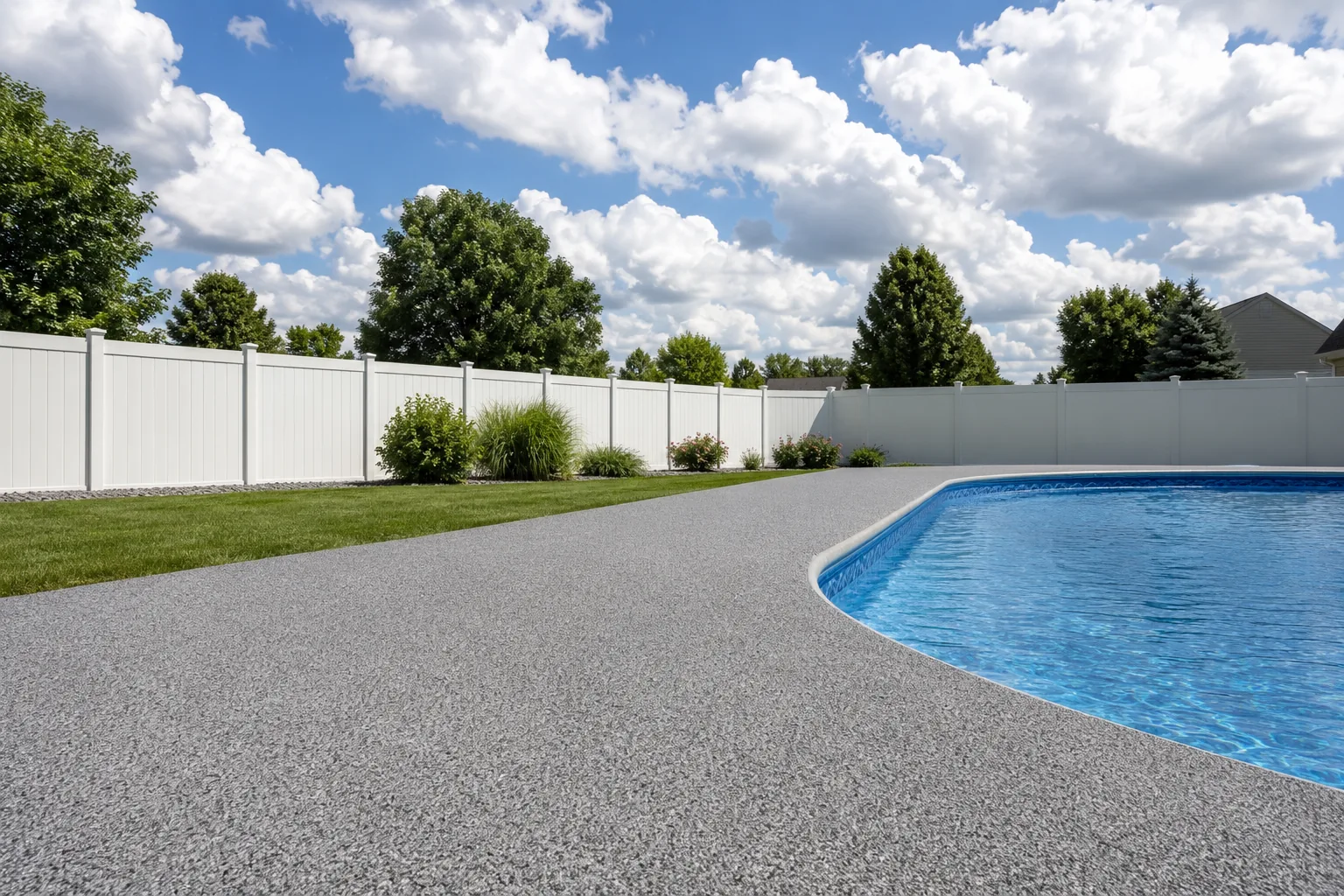
Why Wichita pool decks take a beating
Sedgwick County sits on expansive clay soils that swell when wet and shrink when dry. An exterior patio or pool deck feels that movement more than a garage slab under a roof, because it also takes rain, irrigation overspray, and the full freeze-thaw cycle with nothing between the concrete and the weather.
Add Kansas summers — long stretches of high UV and afternoon surface temperatures that can make dark concrete painful barefoot — and you have a specification problem, not a paint problem. The coating has to stay flexible enough for seasonal movement, opaque enough to reject UV, cool enough underfoot in light colours, and textured enough that wet feet do not skate.
Neighborhoods from east Wichita through Andover and south through Derby and Haysville see the same pattern: broom-finish decks that spall at the edges, stamped concrete with traffic paths worn to bare grey, and older cool-deck overlays that have delaminated in sheets. West-side homes in Goddard and Maize add wind-driven grit and more irrigation splash along pool fences.
Cool-deck colour and texture
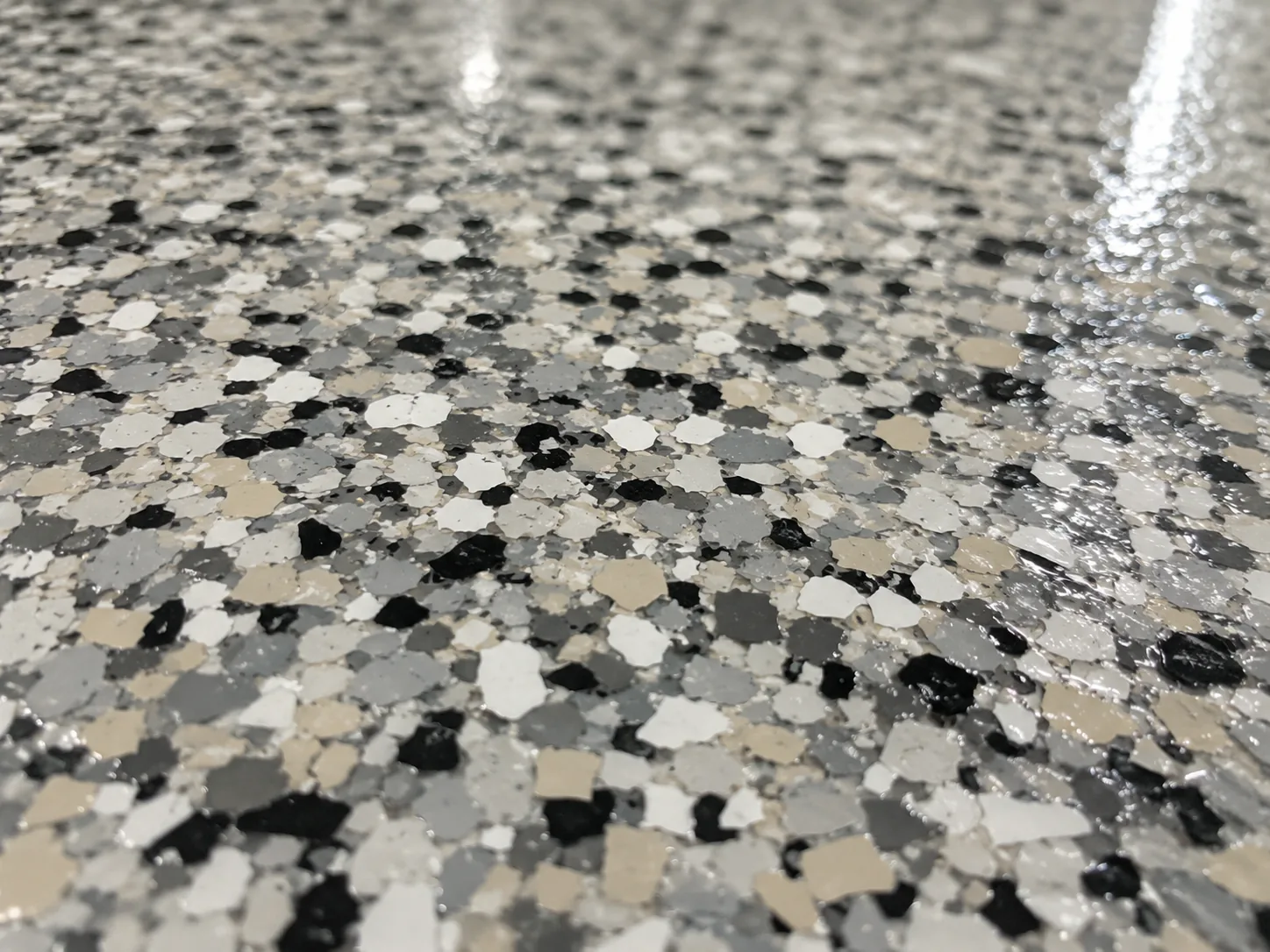
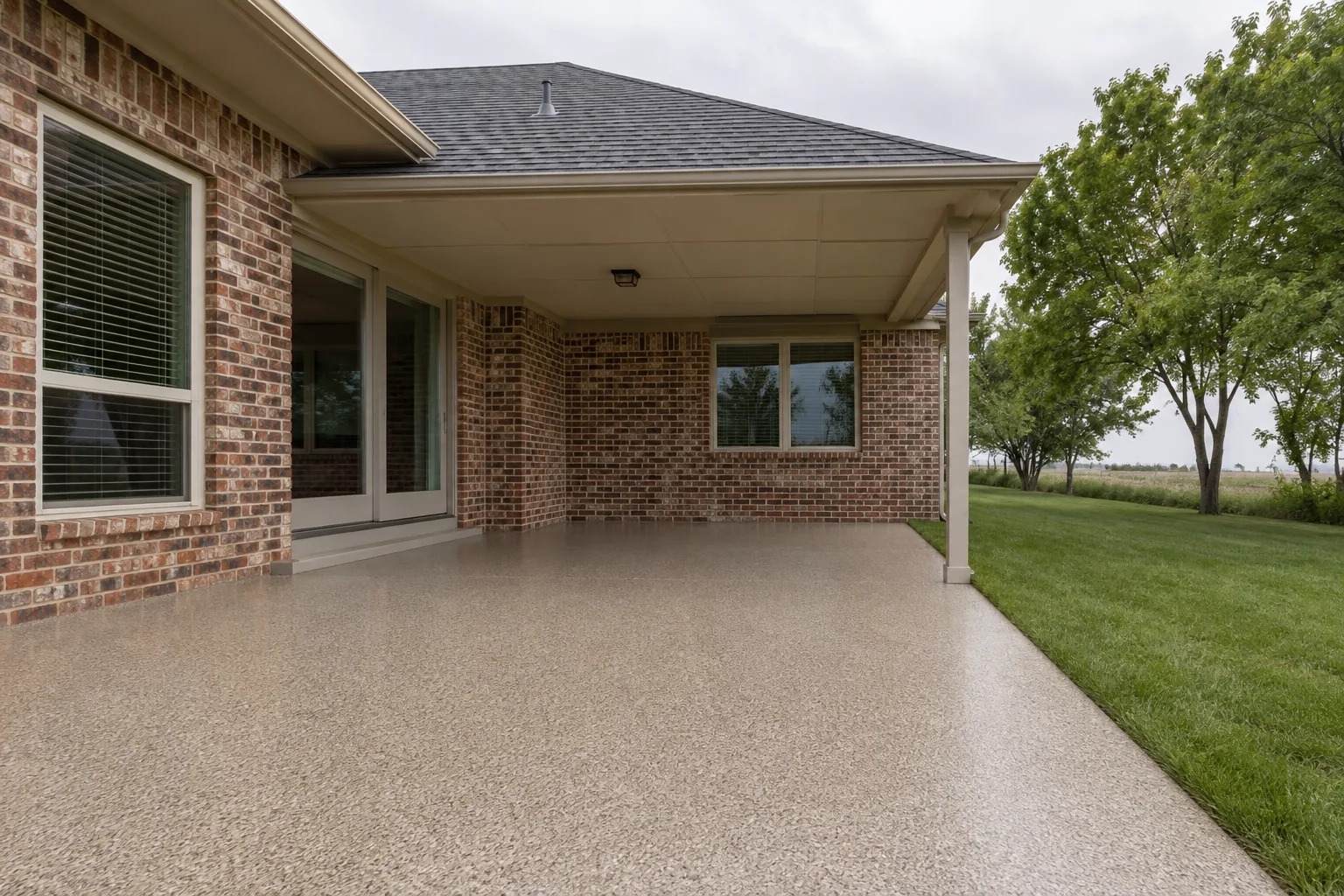
Light tans, sand tones and creams in a textured quartz system run meaningfully cooler than a dark smooth surface. There are also topcoats formulated to reduce heat absorption. For a deck that takes full afternoon sun — which is most Wichita backyards without heavy tree cover — we usually spec both a light field colour and a textured broadcast.
Texture is not optional next to a pool. A full quartz broadcast gives genuine wet traction. A polymer grit in the clear coat helps on lighter systems. Smooth, high-gloss exterior films look sharp in photos and feel dangerous the first time someone steps out of the water.
The freeze-thaw problem outdoors
An exterior slab in Wichita is often the hardest-worked concrete on the property. It takes the full freeze-thaw cycle with no roof keeping water off it. Water soaks into the surface, freezes, expands by roughly nine percent, and prises the top layer apart. Do that dozens of times a winter and an unprotected patio or pool deck starts spalling — the familiar pitting and edge crumbling you see across Sedgwick County every spring.
A sound coating helps by keeping water out of the concrete in the first place. It only helps if the film is genuinely bonded at every edge and joint. Water that gets underneath and freezes there does more damage than no coating at all.
| Factor | Why it matters on a Kansas exterior slab |
|---|---|
| Freeze-thaw cycles | Dozens per winter; primary driver of surface spalling |
| Expansive clay | Seasonal swell/shrink under the slab; joints must flex |
| Drainage | Ponding water is freeze damage waiting to happen |
| Edge and joint detail | Where water gets under the film and freezes |
| Summer surface heat | Light colours + texture keep decks usable barefoot |
| UV | Requires an aliphatic topcoat — epoxy alone will chalk |
| Pool chemistry | Splash-out of chlorine or salt water is routine |
Expansion joints and clay movement
Exterior slabs move more than interior ones. They see a January night well below freezing and an August afternoon baking the surface, sometimes crossing freezing twice in the same twenty-four hours. Underneath, clay subgrades in much of Wichita, Bel Aire, Park City and Valley Center swell and shrink with rainfall and drought.
Expansion joints exist to absorb that movement. They must be honoured through the coating rather than filled and coated over. A flexible sealant in the joint, with the coating terminating cleanly at each side, is the correct detail. Coating straight across an expansion joint guarantees a crack along that line within a season.
What we typically coat
Most Wichita-area pool decks and patios fall into a few buckets:
- Broom-finish concrete. The most common and usually the easiest case. Diamond grind, repair spalls, coat with quartz or grit topcoat.
- Stamped concrete. Usually coats well. Texture carries through; a new system is often the economical way to restore colour worn off traffic paths.
- Worn cool-deck / Kool Deck overlays. If the overlay is sound and bonded, it can sometimes be abraded and recoated. If it is delaminating, it has to come off first — that labour belongs in the quote up front, not as a surprise mid-job.
- Previous epoxy or acrylic that is peeling. Failed film comes off. New coating over loose material fails on a short timer.
How a pool deck job actually runs
- On-site look. We walk the deck, note ponding, cracks, prior overlays, coping transitions and drain locations — not just square footage.
- Moisture and bond checks. Exterior slabs can still push vapor; prior coatings get adhesion checks so we are not coating over a failure waiting to happen.
- Mechanical prep. Diamond grinding or aggressive abrasion to a profile the system can lock into. We do not acid-etch exterior decks as a shortcut.
- Repairs. Spalls patched, cracks addressed, joints planned for flexible sealant rather than bridged with rigid film.
- Broadcast and topcoat. Quartz or textured system in a light, cool colour field, finished with an aliphatic clear built for UV and pool splash.
- Cure and return to use. Foot traffic timing depends on product and temperature; we leave you specific windows before wet play resumes.
Most residential decks are scheduled in a single working day once prep scope is clear. Larger wraps, heavy overlay removal or major leveling add time. Spring and early fall book fastest around Wichita because homeowners want the work done before peak swim season or before hard freezes.
Drainage first
Before any exterior coating, water has to go somewhere. A deck that ponds after a summer storm will pond after coating, and standing water sitting on any film for days is hard on edges — especially where the wet-dry cycle concentrates.
If your deck has a low spot, address it before coating. Sometimes that means a levelling mortar; occasionally it means accepting that a section should be replaced. Either way it is cheaper to know before than after. We flag drainage issues at the measure so the quote reflects reality.
Maintenance after install
A coated patio or pool deck is low maintenance, not zero. Rinse off fertilizer, leaf tannins and pool splash when you notice them. Avoid leaving undiluted shock or concentrated chemicals in a puddle on the surface. Soft brushes and mild cleaners beat harsh solvents. Recoat windows depend on traffic and sun exposure; a well-built aliphatic system is meant to go years, not one season, before any refresh conversation.
Winter: keep drains clear so meltwater does not sit. De-icers are less of an issue on a pool deck than on a driveway, but chloride tracked from the street onto adjacent patio steps still belongs off the coating when you can.
What a real exterior quote should say
Ask for the preparation method, how failed overlays are handled, joint detail, broadcast type (quartz vs grit), topcoat chemistry by product family, and colour/heat strategy. A one-line price with no prep language is not comparable to a line-item exterior scope. The difference between a deck that survives Kansas weather and one that peels at the waterline is almost entirely in prep and terminations — neither of which you can see once the clear coat is down.
Common questions
How does a coated pool deck survive a Kansas winter?
The coating's job is keeping water out of the concrete, which is what prevents freeze-thaw spalling. A sound coated deck comes through winter better than bare concrete does.
What matters is drainage and edge detail. Water that ponds on the surface, or gets under the film at a bad edge and then freezes, does more damage than no coating at all. We spend real time on terminations for that reason.
How does it handle pool chemicals?
An aliphatic topcoat handles chlorinated water, salt systems and normal shock chemistry without issue. Splash-out is routine and the surface is designed for it.
Avoid letting undiluted chemicals sit on the surface — concentrated shock left in a puddle can mark almost any coating.
Will the deck be too hot to walk on in July?
Colour and texture drive barefoot comfort more than brand names. Light tan, sand and cream quartz systems stay far more usable than dark smooth films under Wichita afternoon sun. We treat heat as a specification item on the quote, not an afterthought.
Can you coat over old Kool Deck or stamped concrete?
Often yes if the substrate is sound and bonded. Delaminating overlays have to come off first. Stamped decks usually take a new system well and keep some of their texture. We assess bond at the measure rather than guessing from photos.
How long before we can use the pool deck again?
Foot traffic is often possible within hours to a day depending on the system and temperature; full wet use and furniture back on the deck follow the cure window we leave in writing. Rushing that window is one of the few ways to damage a fresh exterior film.
Do you work outside city limits?
Yes — Wichita plus Derby, Andover, Goddard, Maize, Bel Aire, Park City, Haysville, Valley Center and nearby south-central Kansas. See service areas for the map of communities we cover.
Ready for a deck that handles Kansas weather?
Free on-site measure, honest assessment of your patio or pool deck, and a written quote you can hold us to.