Homeowners comparing epoxy garage floor cost, garage floor coating cost, and epoxy floor cost per sq ft usually want a ballpark before they book measures. Published national guides disagree on exact bands — which is expected when products, prep, and labor markets differ — so treat every figure below as a typical public range, not a Wichita bid. Your slab, moisture, old coatings, and flake density move the number. The only figure that binds is a written on-site quote.
Primary sources checked for this page include HomeGuide’s garage floor coating and epoxy flooring cost guides and Angi’s epoxy flooring cost article (2026 updates). Fixr publishes higher epoxy installed bands than HomeGuide; we note that spread rather than pretending there is one true price.
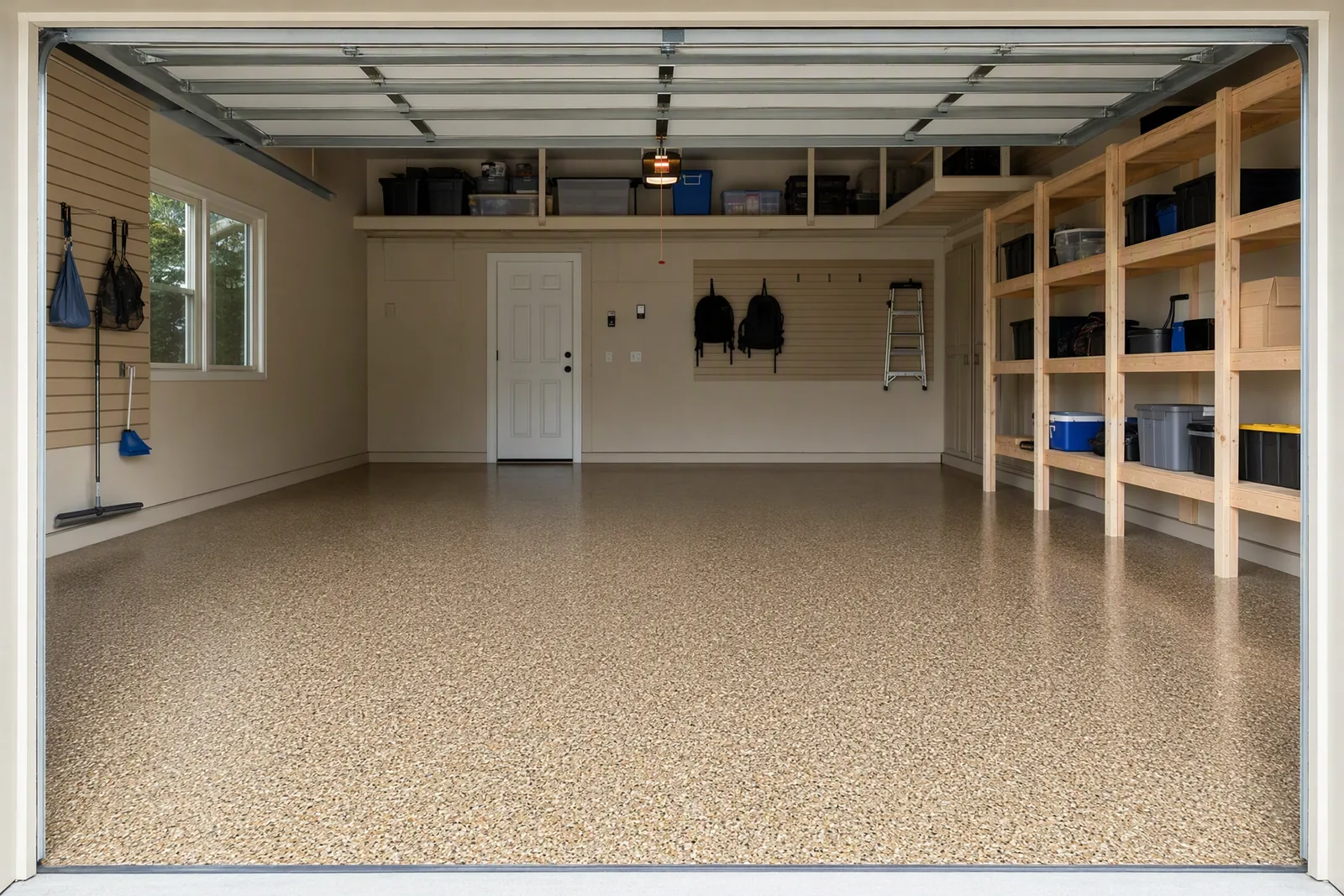
Typical national cost per square foot by system
HomeGuide (2026) frames professional garage floor coating roughly at $4–$12 per square foot installed, with epoxy often cited around $4–$10, polyurea around $5–$10, and polyaspartic around $5–$12 per square foot. Angi describes professional epoxy flooring more broadly as about $2–$12 per square foot including materials and labor, with DIY kits often near $2–$5 per square foot for materials. Fixr has published epoxy concrete coating figures in a higher about $10–$15 per square foot installed band — useful as an upper reference when quotes include heavy prep or premium systems.
| System (typical national guides) | Installed $/sq ft (public ranges) | Notes |
|---|---|---|
| Solid-color epoxy | About $4–$10 (HomeGuide epoxy band) | Lower decorative cost; shows tire marks more |
| Full-broadcast flake epoxy hybrid | Often mid-to-upper coating range | Most common residential look |
| Polyurea-forward | About $5–$10 (HomeGuide) | Fast cure; strong abrasion story |
| Polyaspartic-forward / aliphatic topcoat systems | About $5–$12 (HomeGuide) | UV and hot-tire performance; faster return |
| Metallic epoxy | Often above solid/flake midpoints | Skill- and prep-sensitive; show garages |
| DIY kit materials | About $2–$5 (Angi) | Excludes pro grind, moisture plan, warranty labor |
Ranges vary by region, freighter costs, and how much repair is bundled. Kansas labor and winter demand can shift seasonality. Always compare line items: grinding, crack repair, moisture mitigation, flake coverage, and topcoat chemistry.
Typical garage totals (derived from per-sq-ft ranges)
These examples multiply published per-square-foot bands by common garage sizes. They are illustrative national math, not local averages we invented.
| Garage | Assumed sq ft | Using ~$4–$12 / sq ft (HomeGuide coating band) | Angi-style examples (their published size table) |
|---|---|---|---|
| 1-car | ~250–300 | Roughly $1,000–$3,600 | Angi lists ~250 sq ft at about $750–$3,000 |
| 2-car | ~400–500 | Roughly $1,600–$6,000 | Angi lists ~500 sq ft at about $1,500–$6,000; HomeGuide 2-car totals often cited ~$1,600–$6,900 depending on footprint |
| 3-car | ~750–864 | Roughly $3,000–$10,400 | Angi lists ~750 sq ft at about $2,250–$9,000; HomeGuide larger 3-car footprints run higher |
HomeGuide’s epoxy flooring guide also breaks garage epoxy roughly as 1-car about $1,200–$3,900, 2-car about $1,600–$5,800, and 3-car about $2,300–$8,600 for stated size bands — again national, installed ranges. If a phone quote lands far below every public band with “prep included,” ask what prep means.
What pushes a quote up or down
- Surface prep. Diamond grinding is baseline for durable systems. Heavy profile work, oil contamination, or leveling adds labor.
- Crack and spall repair. Routed polyurea cracks and patch work are priced by linear foot and area — see crack and spall repair.
- Old coating removal. Failed paint or DIY epoxy must come off. See removing failed coatings.
- Moisture mitigation. Elevated vapor drive can require primers or barriers before a decorative system. See moisture testing.
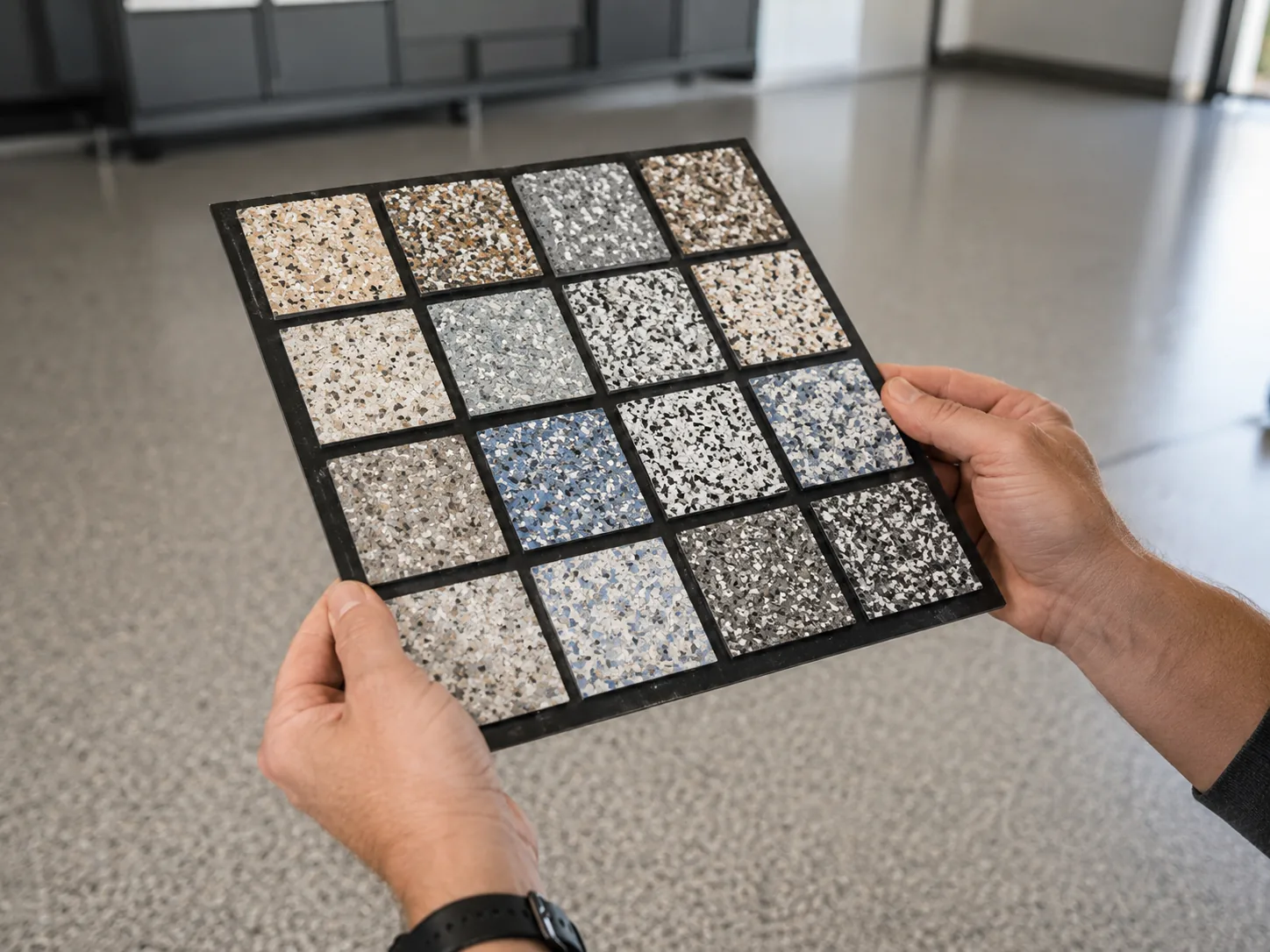
- Flake density and blends. Full broadcast to refusal uses more material than a light spainkle; custom blends cost more than house standards. See colors and flake blends.
- System chemistry. Polyaspartic-forward floors often price above basic epoxy body coats because of material cost and application skill — compare on epoxy vs polyaspartic vs polyurea.
- Access and schedule. After-hours commercial work, occupied homes with tight staging, or detached shops with limited power can add cost.
Epoxy flooring cost vs polyaspartic floor coating cost
Public guides often place polyaspartic garage systems at a premium to basic epoxy. HomeGuide’s coating-by-type table puts polyaspartic roughly in a $5–$12 per square foot installed band versus epoxy around $4–$10. That premium buys faster cure, better UV stability at the surface, and stronger hot-tire behavior when the system is specified correctly. Whether it is “worth it” depends on how long you keep the house, how much sun hits the slab near the door, and whether you can leave cars out for a classic epoxy cure. We quote both approaches when they fit the slab.
DIY kit vs professional install
Angi notes DIY epoxy kits can land about $2–$5 per square foot for materials, while professional labor alone may add on the order of roughly $1–$7 per square foot depending on market and scope. Kit failures in Kansas usually trace to skipped grinding, no moisture test, thin film build, and no aliphatic topcoat. Redo cost after a peel often exceeds doing it once with mechanical prep. Deep dive: DIY kits vs professional.
How to use these numbers. Multiply your measured square footage by a mid-range figure for planning, then budget contingency for cracks and moisture. Call for a free on-site quote before you finalize a remodel budget — photos alone miss oil saturation and vapor drive.
Basements, shops, and other spaces
Epoxy basement floor cost follows similar per-square-foot logic but moisture mitigation is more often required — see basement floor coatings. Shop and warehouse floors may need thicker build, chemical-resistant topcoats, or non-slip quartz; planning ranges still start from the same national $/sq ft bands but climb with thickness and downtime constraints — see shop floor epoxy and commercial and industrial flooring.
What a written quote should include
- Exact square footage and areas excluded (steps, utility pads)
- Grind method and whether old coatings are removed
- Moisture test method and mitigation if needed
- Body coat and topcoat chemistry (not just “epoxy”)
- Flake blend and broadcast level
- Crack/spall allowances
- Cure schedule for foot traffic and vehicles
- Warranty language in writing
For process context, read garage floor coating & epoxy floors and install day expectations.
Worked examples with stated assumptions
These scenarios use midpoint-ish figures from the public bands above so you can see the math. They are not promises of Wichita pricing.
Example A — clean 2-car, flake hybrid
Assume 440 sq ft, sound slab, light crack repair, full flake, polyaspartic topcoat. Using $7 / sq ft as a planning midpoint inside HomeGuide’s broader $4–$12 coating band: 440 × $7 ≈ $3,080 before tax and before unusual moisture work. A quote might land lower on a pristine slab or higher with oil cuts and extra crack footage.
Example B — 1-car with failed DIY peel
Assume 280 sq ft plus full removal of a peeling kit. Removal and re-grind can add meaningfully on top of the coating band — sometimes on the order of additional dollars per square foot depending on how stubborn the failure is. Budget contingency; do not compare this job to a bare-slab neighbor’s price.
Example C — 3-car show garage, metallic
Assume 780 sq ft, metallic body coat, premium clear. Metallic work often prices above solid/flake midpoints because of labor skill and material. Using an $10 / sq ft planning figure inside upper published bands: 780 × $10 ≈ $7,800 directional — then confirm UV topcoat and slab flatness at measure.
Materials vs labor in public guides
HomeGuide breaks garage coating roughly into materials about $1–$6 and labor about $3–$6 per square foot within its total $4–$12 framing. Angi similarly notes labor as a large share of professional epoxy jobs (on the order of roughly one-third to about two-thirds in their discussion) and cites labor examples around $1–$7 per square foot or hourly crew rates. That split explains why two bids with “the same flake color” diverge: one may under-price grind time or omit moisture testing.
Seasonal timing in Wichita
Interior garage work runs year-round when the space can be warmed and ventilated, but spring and early fall are popular because cars can sit outside more comfortably during cure. Peak demand can lengthen lead times; it does not invent a separate price list. Exterior-adjacent work (thresholds, detached shops without climate control) is more weather-sensitive.
Cost per year of service
A cheaper film that peels in three years is not cheaper. If a light water-based system lasts a handful of years and a well-built polyaspartic-topped flake system lasts much longer (HomeGuide cites wide lifespan bands by chemistry), divide installed cost by expected service years when you compare. Include the hassle cost of emptying the garage again for a redo.
Common questions
What is the average epoxy garage floor cost?
National guides commonly land a typical two-car project in a wide band around the low-to-mid thousands up through several thousand dollars depending on system and size — for example HomeGuide’s coating totals for 2-car footprints and Angi’s ~$1,500–$6,000 example for a 500 sq ft garage. Local bids vary; use a free on-site measure.
How much is epoxy floor cost per sq ft?
HomeGuide often cites about $4–$10 per square foot for epoxy flooring installed and about $4–$12 for garage coatings broadly. Angi cites about $2–$12. Fixr has published higher epoxy bands near $10–$15. Overlap is imperfect because guides define “epoxy job” differently.
Why is one quote twice another?
Usually prep scope, moisture plan, flake density, and topcoat chemistry — not magic. Compare line items, not just bottoms.
Does polyaspartic always cost more?
Often yes on day-one price in published tables, but faster return to service and longer wear can change cost-per-year. Ask for both options when your schedule is tight.
Are online calculators accurate?
They are planning tools. They cannot see your oil spots or vapor drive. Treat them like the tables above: directional only.
Ready for a floor that survives a Kansas winter?
Free on-site measure, honest assessment of your slab, and a written quote you can hold us to.
Call 316-799-3692 Request a quote online